Eclipses v1 0, p.1
Eclipses (v1.0), page 1


16-03-2023
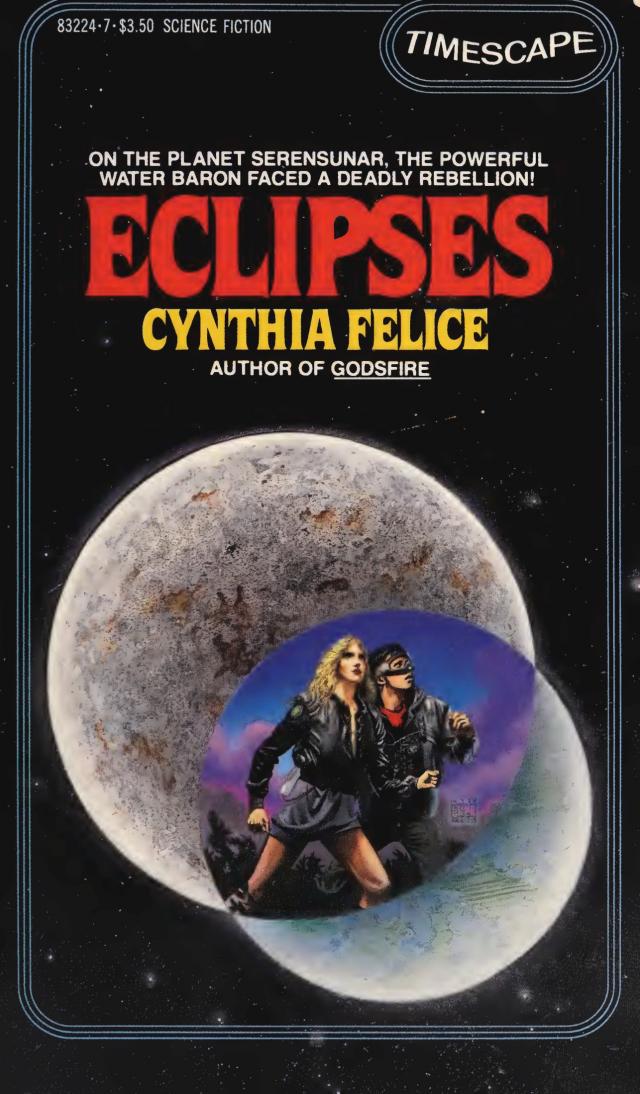
On a Distant Planet,
a lone Earthwoman
Escapes Violent Death!
When the man got up, Beth gasped. His posture looked menacing … He shouted, pointing toward the cliff where Beth stood. The timbre of his voice carried, but Beth never knew if words had brought the message to her or if she had seen the bright yellow fuse box at that instant …
She had walked into a blasting area. The detonation of the explosives—set where? in the cliff beneath her feet?—had been prevented by the man, who had probably saved her life. But from the angry look on his bloodied face as he strode toward her, he was coming to claim it …
Books by Cynthia Felice
Eclipses
Godsfire
Published by TIMESCAPE BOOKS
Most Timescape Books are available at special quantity discounts for
bulk purchases for sales promotions, premiums or fund raising.
Special books or book excerpts can also be created to fit specific needs.
For details write the office of the Vice President of Special Markets,
Pocket Books, 1230 Avenue of the Americas, New York, New York
10020.
ECLIPSES
Cynthia Felice
A TIMESCAPE BOOK
PUBLISHED BY POCKET BOOKS NEW YORK
Contents:-
BOOK ONE Chapter 1
Chapter 2
Chapter 3
Chapter 4
Chapter 5
Chapter 6
Chapter 7
Chapter 8
Chapter 9
BOOK TWO Chapter 10
Chapter 11
Chapter 12
Chapter 13
Chapter 14
Chapter 15
Chapter 16
BOOK THREE Chapter 17
Chapter 18
Chapter 19
Chapter 20
Chapter 21
Chapter 22
BOOK FOUR Chapter 23
Chapter 24
Chapter 25
Chapter 26
Chapter 27
Chapter 28
Chapter 29
Chapter 30
Chapter 31
Chapter 32
Chapter 33
This novel is a work of fiction. Names, characters, places and incidents
are either the product of the author’s imagination or are used
fictitiously. Any resemblance to actual events or locales or persons,
living or dead, is entirely coincidental.
Another Original publication of TIMESCAPE BOOKS
A Timescape Book published by
POCKET BOOKS, a Simon & Schuster division of
GULF & WESTERN CORPORATION
1230 Avenue of the Americas, New York, N.Y. 10020
Copyright © 1983 by Cynthia Felice
All rights reserved, including the right to reproduce
this book or portions thereof in any form whatsoever.
For information address Timescape Books, 1230
Avenue of the Americas, New York, N.Y. 10020
ISBN: 0-671-83224-7
First Timescape Books printing June, 1983
10 9 8 7 6 5 4 3 2 1
POCKET and colophon are registered trademarks
of Simon & Schuster, Inc.
Use of the trademark TIMESCAPE is by exclusive license
from Gregory Benford, the trademark owner.
Printed in the U.S.A.
For Bob,
More
BOOK ONE
Chapter 1
A shadow fell across the map in Beth’s hands. She glanced up. Brightly plumed birds were settling into the twisted branches of spiral oak trees along the creek bed and giving forlorn-sounding night calls, tuweer tuweer, as if lamenting a short-lived day. The birds were accustomed to the effects of a double-planet system that caused a solar eclipse every tenth day on Serensunar. Beth was not. On Earth she had often forgotten the existence of the moon, for she had spent most of her time in the museum’s basement or behind the shutters in her apartment. But she could not forget Hunted Moon, as the sister planet was called. It was too large and brilliant to overlook. It was six times wider than Earth’s moon and covered with lustrous blue-white clouds with occasional murky patches that were smoke clouds from volcanic explosions. A total eclipse—and all of them were total—brought darkness for more than an hour. Beth shook her head and refolded her map. The long valley was growing quite dark.
There was a regular moon, too, a little white thing that was barely discernible as a disk to the naked eye. It rose swiftly out of the western sky at least once each day and night, though solar brilliance usually made it invisible during the day.
Pocketing the map, Beth moved on. She could walk through the valley during the darkness since there was a dirt road to follow. It wasn’t much of a road; just two narrow ruts to accommodate small survey vehicles and scooters. These two ruts were the height of luxury to Beth, who was forced to follow the trail of the Lost Expedition overland on a continent almost entirely without roads.
The road would be widened soon, for she’d seen heavy construction equipment carried in by dirigibles that swiftly skimmed the treetops on their way to the tiny airport at the neck of the upper valley. Other equipment and most of the workers would come by rail, for there was a big railhead not far from the airport. Nothing would come by road.
Beth walked briskly, partly to ward off the growing coolness and partly because such a pace was natural to her when the way was clear.
When the sun began to make its presence known again, it was in the form of her own faint, soft shadow preceding her in the red ruts. The way was getting muddy, foliage thicker and larger, for this was the lower end of the valley, subject to more precipitation and more runoff than the upper valley and the peaks above that. In a few years the ground she was walking on would be under water, for this lower valley was faulted in just the right way to be closed off by a dam that would form a reservoir, one whose banks would brim the upper valley.
The Water Baron lived in the upper valley. Local inhabitants called him Calib, and Beth knew this proposed dam was not the first he’d built in these mountains. She had no doubts about his right to build the dam, though he seemed to have more rights than anyone else on the planet, and she had no argument with the need for the dam. She’d seen his vast orchards when they were thick with russet blossoms, filling the air with a fragrance she’d never smelled before; indeed, she’d gone kilometers out of her way just to investigate what looked like an orange carpet flowing halfway up the mountainside. And she’d met Calib, the Water Baron of SERENSUNAR, pruning shears in hand, though it was impossible to see what he expected to prune, strapped in as he was to the padded seat of a miniature electric car. She didn’t have a chance to ask him because he asked all the questions, not at all sharply nor lordly as his formidable reputation had led her to believe he might. She quickly realized he was a very old man who was polite and extremely curious about her and her work. Under other circumstances she might have considered him nosy, but she was in his mountains searching for the old camps of the Lost Expedition by his sufferance. So she’d answered his questions cheerfully and found herself captivated by his quick wit, charm and the twinkle of lapis lazuli beneath shaggy gray brows.
Too late she realized the hour or more of conversation had tired Calib, and that he’d begun dozing even while they talked. She awakened him twice by calling his name, but the third time he didn’t respond. He looked comfortable in the padded contours of his chair, and she supposed that he’d be safe napping in the shade of his own orchard; but she didn’t feel right about abandoning an elderly and probably ill man. While Beth listened to his snores and wondered what to do, his electric car came to life, its motor whirring busily for a second before it rolled forward. Quickly Beth ran after it, certain the brake had slipped and that Calib would plunge down through the orchard to the rocky lower valley.
The car slowed to circle an apple tree. She cut across the orchard to intersect the car’s new direction of travel. It stopped short of where she was and a metallic armlike thing popped out of a compartment above the front wheel to reach for a slender, polished rod that lay among the petals and turf on the ground. Beth stopped running, panting hard, and watched as the arm clamped the rod against the plastic fenders. She quickly surmised it had picked up an extension handle for Calib’s pruning shears. The car’s activity was all too purposeful to be the result of slipped brakes or even the motor’s running amok. Now she watched curiously.
The car backed itself away from the-tree trunk, turned sharply and went to another tree. It realigned its body so that the arm could reach another shiny tool. It grabbed and clamped. Now the car turned, gently; the turns all had been slow and gentle, as if Calib’s rest should not be disturbed. But once centered between two rows of trees, the car accelerated and sped away. Beth couldn’t have caught it now if she tried,
but she took her field glasses out of her pack to see where the car would go.
Far upslope she could see Calib’s mansion, which looked like almost every other house that Beth had seen in the Empire despite its being much larger. Every window was recessed and in the shadow of overhanging eaves; the line of it was long and low along the many wings, rising to a second story only in the center. There were solar collection panels on one side of the roof. She thought that the other side might be a huge skylight, but maybe it was just a different style of solar collection panels. There wasnâ€
At the house, Beth could see someone standing on the big porch. The car, containing Calib, was running alongside a long stone path through the vast lawn. When it reached the house it rolled up a ramp over the left side of the stairs, across the porch and right through the open double doors into the house. The person on the porch followed the car and closed the doors.
Now, as Beth remembered the episode, she chuckled over her alarm for Calib as much as the behavior of the little car. It was like a faithful dog in the way it had fetched his tools before taking him back to the house, almost as if it knew that even Serensunar’s Water Baron, who probably could afford to replace any number of tools, still would appreciate not losing track of some. The planet had an extensive technology and good manufacturing capabilities, but the products were so durable and reliable that there wasn’t a constant demand for replacement. The factories had temporarily stopped production of certain items and as a result, some things were unavailable at any price. So even the Water Baron might not be able to replace a few lost tools with new ones.
But it was Calib himself she thought of most. Even though she’d not directed the conversation with him at all, she later realized that she’d learned a great deal about the surrounding countryside from Calib; he tended to comment a lot even while putting questions to her. So when she discovered someone surveying the high end of her canyon, marking the way for the construction of a water chute, she realized the tiny trickling stream that ran through her canyon was the canyon to which a confluence of mountain streams and rivers would be diverted until the dam in the valley was complete. Her canyon was narrow, the rivers were wide. It wouldn’t do. She wasn’t finished with the canyon; indeed, she had barely started exploring it. She would have to go talk to the crew she’d seen working at the other end of the valley. There would be someone with authority there. Beth had cut across country to reach the valley road.
She could see them now in the dawnlike light of the waxing sun, not at the dam site proper but in a field of felled timber well off the road. Ahead, the road had been obliterated by a landslide, something she’d seen frequently in the rift regions southwest of these mountains. But since the continent had to be thick and tough to support the very existence of mountains, she suspected this landslide had not been caused by creep or sudden faulting but probably by the rainstorm a few nights ago. Beth turned off the rutty track on an angle that would intercept the work crew, picking her way more carefully amid boulders and clumps of slippery vegetation. The sun was beginning to warm her shoulders and back, a luxurious feeling after the long, cool eclipse. She heard a sharp shrill whistle that she had never heard before. She was always hearing new birdcalls, especially now that it was spring.
Beth stopped abruptly when she realized the spit of land she had been walking over dropped off a few meters, a slab of stratum covered with earth and overgrown. She could see the crew below clearly now, several lounging in the vehicles. Two more were in the foreground, a short man and a woman who was unusually robust. When Beth started to climb down the kittle cliff, she heard a hoarse shout. Her head jerked up in alarm.
Below her the man abruptly shoved the woman, who lost her balance and fell to one knee. The next second the man was staggering from an uppercut to his face, but he managed to avoid a second blow by ducking beneath her fist and landing one of his own to the woman’s stomach. The big woman swayed and clutched her stomach, momentarily dazed, then rushed her attacker like a crazed animal and knocked him over with her bulk, fists pummeling like pistons. When the people from the vehicles reached the fighters and pulled the woman up, it appeared to take their combined strength to hold her back.
Beth stared, feeling faint, unaware that she’d been holding her breath since the fracas began. When the man got up, Beth gasped. His posture looked menacing, and for a panicky moment she thought someone was needed to hold him back, too, and no one was left to do it. But then his attention seemed only partially on the big, struggling woman; he shouted, pointing toward the cliff where Beth stood. The timbre of his voice carried, but Beth never knew if words had brought the message to her or if she had seen the bright yellow fuse box at that instant and had formed the entire scenario on her own. She had walked into a blasting area. The people at the vehicles were not lounging but were taking shelter there. The detonation of the explosives—set where? in the cliff beneath her feet?—had been prevented by shoving the woman away from the fuse box. The man who had taken the beating probably had saved her life, and from the angry look on his bloodied face as he strode toward her, leaping fallen logs, he was coming to claim it. Beth turned on her heel in blind panic, scrambled up the slope and ran all out for the road. She’d barely touched it when she thought she heard the roar of a combustion engine; she charged downslope and crashed through the bushes to the trees where a vehicle could not follow, her legs slowing down to make the quick turns but her heart pounding faster. Out of the trees she skimmed over a clearing, the uphill climb of no concern to her adrenaline-filled body. She stopped only when there was nothing left with which to run, no energy, no breath, and finally no will. She dropped behind a tree trunk, needing huge gasps of air, but so frightened the sound of her ragged breathing might be heard that she covered her mouth with her hands to muffle the noise.
When Beth could finally breathe regularly again, she also found her senses restored; she could think and see and hear. The birds were warbling overhead, already accustomed to her presence. They would be silent if anyone were moving about, so she knew no one was nearby. She reasoned that she had eluded her pursuer and perhaps a lot of pain as well. She was bothered by knowing that she had not accomplished what she had set out to do. But it didn’t occur to her to return to the blasting site, not even after tempers had had a chance to cool. That she might have lost her life on that tiny bluff had the explosives been detonated was of much less consequence to her than the raw anger she’d seen, and the fear of it was enough to make her know she would avoid the dam site for as long as she was in the region. She didn’t want to risk running into any of the people down there, especially not the huge woman or the angry man. Beth trembled to think of how quickly the fight had started—between eyeblinks and with no warning! No, she wouldn’t go back there again.
She got up from the place where she’d lain so long, legs so fatigued they barely held her. Her skin was crusted with dried sweat, and as soon as she stepped out of the tree’s shadow, the sun’s heat added to her discomfort. Only the memory of that man’s infuriated face as his anger drove him after her kept her walking briskly back to camp.
Chapter 2
Aram was sitting on the grass, leaning against the fender of the miniature car in which his father sat. It was morning, but the older man had already dozed off in the sun, even while talking to Aram. Aram leaned over at the first sound of the motor starting up and overrode the memory units that would have returned the car with Calib in it to his first-floor room in the mansion. The car had been a blessing when Calib had first started suffering from recurring phlebitis; it was impossible to keep him housebound, and, of course, every step he took was not only dangerous but also painful. The sleeping had come later, not as a result of the phlebitis but because of the circulatory problems that aggravated both conditions. Aram had copied a program that had been used in Earth’s microcomputer-controlled army tanks. The computer was activated when an implant in Calib’s brain registered alpha waves for more than two minutes, or if another monitor indicated cardiac distress, though so far the second had not come into play.