Uss battlestrike, p.1
USS Battlestrike, page 1
part #15 of USS Hamilton Series


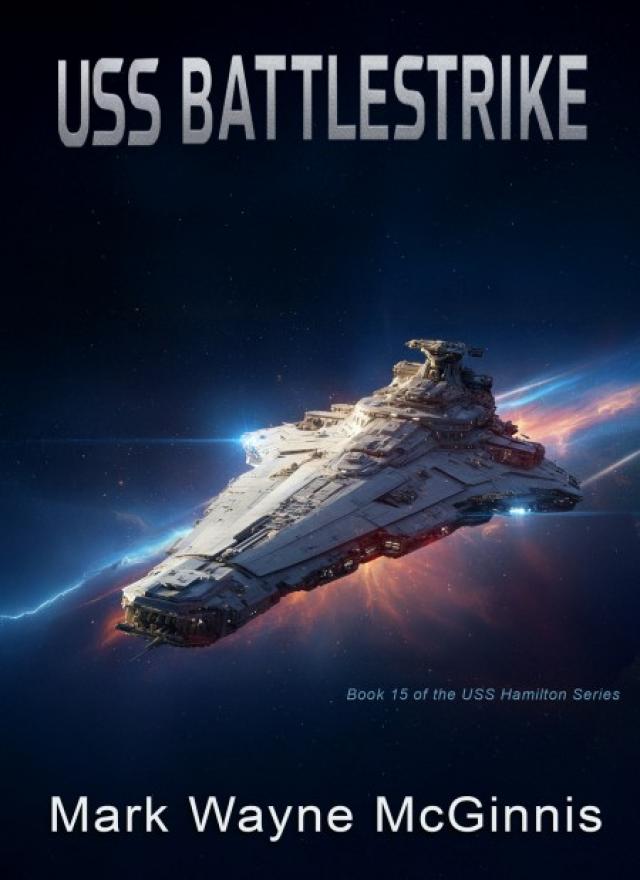
USS Battlestrike
USS Hamilton Series
Book 15
Mark Wayne McGinnis
Copyright (c) 2025, by Mark Wayne McGinnis. All rights reserved. No part of this publication may be reproduced, distributed, or transmitted in any form or by any means, including photocopying, recording, or other electronic or mechanical methods, without the prior written permission of the publisher, except in the case of brief quotations embodied in critical reviews and certain other noncommercial uses permitted by copyright law.
For permission requests, write to the publisher, addressed "Attention: Permissions Coordinator," to the email address below. This is a work of fiction. Apart from well-known historical figures and actual people, events, and locales that figure in the narrative, all other characters are products of the author's imagination and are not to be construed as real.
Any resemblance to persons, living or dead, is entirely coincidental. Where real-life historical persons appear, the situations, incidents, and dialogues concerning those persons are not intended to change the entirely fictional nature of the work.
Published by Avenstar Productions: info@avenstar.net
USS Battlestrike EBook
ISBN: 979-8-9922871-6-5
USS Battlestrike Paperback
ISBN: 979-8-9922871-7-2
To join Mark's mailing list, jump to:
http://eepurl.com/iCGBXk
Visit Mark Wayne McGinnis at:
http://www.markwaynemcginnis.com
Created with Vellum
Formatted with Vellum
Contents
Prologue
Chapter 1
Chapter 2
Chapter 3
Chapter 4
Chapter 5
Chapter 6
Chapter 7
Chapter 8
Chapter 9
Chapter 10
Chapter 11
Chapter 12
Chapter 13
Chapter 14
Chapter 15
Chapter 16
Chapter 17
Chapter 18
Chapter 19
Chapter 20
Chapter 21
Chapter 22
Chapter 23
Chapter 24
Chapter 25
Chapter 26
Chapter 27
Chapter 28
Chapter 29
Chapter 30
Chapter 31
Chapter 32
Chapter 33
Chapter 34
Acknowledgments
About the Author
Also by Mark Wayne McGinnis
Prologue
Washington, DC
EUNF Headquarters
Captain Galvin Quintos
three days prior to deployment...
Ipressed my palm against the cool diamond-glass and watched Washington, DC pretend to be whole again. Years after the last Grish attack, construction cranes still dotted the horizon like mechanical herons, their skeletal arms reaching toward a sky that had once rained fire. I'd been counting them for two hours--counting the cranes like I count the cows on my rural property--while replaying my last conversation with Pristy for the umpteenth time.
Her voice had carried that particular strain of patience that meant she was choosing her words like ammunition--careful, measured, designed to wound.
"I'm not asking you to quit, Galvin. I'm asking you to choose."
The conference room door opened, and Admiral Gilbert entered first, his weathered face etched with the kind of news that wouldn't wait for pleasantries. Behind him came President Cyprian Block, and I felt my stomach drop. The aging president looked like a man who'd been staring into an abyss and found it staring back. Two other officials followed, their uniforms crisp enough to cut glass, their expressions carved from stone.
"Captain Quintos." Gilbert's voice carried a formal edge that clarified that this wasn't a social call. "Thank you for responding so quickly."
"Admiral." I straightened.
My eyes shifted to POTUS. "Mr. President."
Block reached out to greet me. His handshake felt like gripping winter itself. "Captain. I wish we were meeting under better circumstances."
The two unnamed officials took positions flanking the conference table--strategic, not social. Everything about their posture screamed classified, urgent, and probably catastrophic.
President Block's air of authority filled the small space. His eyes met Gilbert's with an almost imperceptible nod.
"Gentlemen, please." Gilbert gestured toward the oval table that dominated the room's center. "What we're about to discuss doesn't leave this room."
We settled into chairs that cost more than most people's annual salaries. The silence stretched tight as a tripwire until Gilbert activated the table's halo-projector with a gesture that looked like he was signing a death warrant.
"Captain, you're familiar with the Techno-Mycoid threat from your time aboard USS Ironfist."
I nodded. Familiar was a polite way of saying I'd watched them turn a star system into a killing machine of metal, organic material, and screaming circuitry. "Yes, Sir."
"Then you understand what we're facing." Gilbert's fingers moved across the control interface. "What you don't understand is how much worse it's become."
The holographic display shimmered to life above the table, casting ethereal blue light across our faces.
What materialized made my breath catch in my throat.
Six star systems hung in miniature splendor, their planets glowing like scattered jewels against the dark. Orbital cities traced delicate patterns around gas giants. Trade routes connected worlds in a web of peaceful commerce that spoke of centuries of cooperation.
"The Zephyrians," Block said, his voice laden with grief. "Six star systems. Thirty-six billion souls. They've been our galaxy's most peaceful civilization for over eight hundred years."
One of the unnamed officials--a colonel whose nameplate read HAYES--leaned forward. "Their technology focuses on terraforming, medicine, and art. They have faster-than-light travel, but their weapons technology is essentially ceremonial."
"Beautiful," I murmured, watching the gentle dance of their civilization.
"Was beautiful," Gilbert corrected, and touched another control.
The display shifted. A stain spread across the projection like cancer, dark and hungry and wrong. Where Zephyrian cities had glowed with warm light, twisted amalgamations of flesh and metal now pulsed with sickly luminescence. Entire worlds looked like they were bleeding chrome.
"Jesus." The word escaped before I could stop it.
"The Techno-Mycoids aren't just conquering anymore," Gilbert continued, his voice clinical in the way that meant he was fighting to stay professional. "They're consuming. Every living thing, every piece of technology, every scrap of knowledge. They're turning the Zephyrians into raw material for expansion."
The hologram zoomed in, showing details that would haunt my dreams. Cities that had become breathing circuits. Organic spires that pulsed with artificial heartbeats. And everywhere, the cybernetic-organic growth that marked the Techno Mycoid occupation like a signature written in corruption.
"Thirty-six billion people," Block said quietly. "We estimate they've assimilated sixty percent already. The rest..." He gestured helplessly at the display. "They're being processed."
Processed. The words churned in my stomach like spoiled milk.
"How long?" I asked.
"At their current rate of expansion?" The second official--REEVES, according to his nameplate--consulted a tablet. "Complete assimilation in eighteen months. But that's not the worst part."
Gilbert manipulated the display again. Red vectors appeared, showing projected movement patterns that spread like infection vectors across the galaxy.
"They're not stopping with the Zephyrians. Every world they consume makes them stronger, faster, more efficient. We're looking at galactic conquest within the next six decades."
I studied the projections, my tactical mind automatically calculating distances, resources, and response times. The math was ugly. "What's our alliance situation?"
"Improving," Block said, and for the first time, his voice carried a note that wasn't pure despair. "The Thine, Pleidians, and Earth alliance is solid. But we've had breakthroughs. The Varapin have agreed to join us. The Tharokyns as well."
"The Tharokyns?" I couldn't hide my surprise. The Neanderthal-like species had been attacked by the Techno-Mycoids and was one of the few civilizations to survive to talk about it.
"Apparently, they've run the projections too," Hayes said with grim humor. "Even they understand that neutrality won't matter when the galaxy's being digested."
"The Grish?"
Gilbert's expression soured. "Still refusing to align with their 'traditional enemies.' Apparently, they'd rather maintain their pride than their existence."
The hologram shifted again, showing fleet compositions, supply lines, and strategic positions. Everything screamed massive military operation.
"Which brings us to why you're here," Block said. He stood, his movements strained by the responsibility of his office. "Captain, Earth has officially declared war on the Techno-Mycoids. We're assembling a battle group of unparalleled strength in technological advancement."
I felt the familiar tightness in my chest that came before every major deployment. The same feeling I'd had before Ironfist, before Jefferson, before every mission that pulled me away from the people I car
"You'll have command of Battle Group Seven," Gilbert continued, "classified designation: Kraken. The most advanced warships we've ever built. Quantum Aperture Conduit Systems for rapid deployment. Weapons that can crack moons."
"Your mission," Block said, his eyes boring into mine, "is to strike at the heart of Techno-Mycoid expansion. Stop them cold. Show them that this galaxy can't be taken without a fight."
Gilbert continued, taking up where Block left off, "Thousands of light-years from Earth. Multiple wormhole jumps through contentious space, which will have little tolerance for intruders. All so this alliance can stop an enemy that, if left unchecked, will one day be showing up at our own doorstep, turning our civilization into components for their war machine."
The gravity of the situation hit me like a slap on the face. And Pristy, soon to arrive at my ranch in Colorado, believing I'd chosen her over the stars. Our impending reunion had me as giddy as a toddler waiting to see what Santa Claus had brought the night before.
"Sir," I said carefully, "the distance involved[?]--"
"Your destination is at the extreme opposite side of the galaxy. Seventy-two thousand light-years," Reeves confirmed. "Seven jumps using the new extended-range QACS technology. You'll be gone for..." He paused, consulting his tablet. "A minimum of four months. Possibly longer."
Four months. I thought of morning coffee on the ranch porch, of Pristy's laugh when Hardy tried to help with the horses, of promises made in hospital rooms that smelled of antiseptic and hope.
"I'm not asking you to quit, Galvin. I'm asking you to choose."
"When do we deploy?" The words came out steadier than I felt.
"USS Battlestrike is completing construction at Halibart Station," Gilbert said. "You'll transfer aboard in seventy-two hours. Full briefing on Kraken's composition, personnel assignments, and tactical parameters will be waiting."
Block stepped closer. "Captain... Galvin, I want you to understand something. When the President of the United States tells you that Earth needs you--that humanity needs you--it's not a request."
"I understand, Sir."
But understanding and accepting were different creatures entirely. I stared at the holographic display, watching the Techno-Mycoid infection spread across Zephyrian space. Thirty-six billion people being processed into raw material for galactic conquest.
Had Pristy arrived at the ranch yet? I'd wanted to be there when she arrived. She was probably feeding the horses and wondering why I hadn't let her know I'd... stepped out.
"There's one more thing," Gilbert said, his tone shifting to something that might have been sympathy. "Your battle group includes several vessels commanded by officers you know. I think you'll find the personnel assignments... interesting."
Something in the admiral's voice made my tactical instincts prickle. "Sir?"
"Captain Gail Pristy will be commanding USS Defiant, one of Kraken's escort vessels."
The room went silent except for the subtle hum of the building's environmental systems. I felt the floor shift beneath my feet--not literally, but close enough. My mind swirled with conflicting thoughts.
"Captain Pristy?"
The corners of Gilbert's lips ticked up. "It's time--she's paid her dues. Gail's a fine officer, and right now, the U.S. Space Navy needs the very best seated within our warships' captains' mounts."
"So, she's... already been assigned?"
"She volunteered," Block said quietly. "Three weeks ago. Apparently, she had her own compelling reasons for returning to active duty."
I stared at the holographic display, watching alien civilizations die in miniature while my own world rearranged itself around me. Pristy had made her choice before I'd even known there was a choice to make.
"Gentlemen," I said finally, my voice finding the professional tone that had carried me through a dozen impossible missions, "when do we save the galaxy?"
Gilbert's smile held no warmth, only the grim satisfaction of a man who'd found the right weapon for an impossible job. "Captain, as previously stated, you leave in seventy-two hours for a mission that will determine the fate of all that's decent."
Outside the windows, Washington DC continued its eternal reconstruction, building new hopes out of the rubble of old fears. And somewhere out there, an enemy that turned worlds into weapons was learning that humanity had decided to fight back.
The holographic display flickered and died, leaving only the reflection of five men who'd just committed to a war.
I straightened my shoulders and began planning for a battle that would decide whether the galaxy lived or died. Some choices, I realized, weren't choices at all. They were just destiny wearing a uniform and asking politely.
Chapter One
Colorado, USA
Coyotes Crossing Ranch
Captain Galvin Quintos
day of deployment...
The two towering bots stood unmoving like metal totems in the barn--Turnpike's optical sensors casting amber light through the shadows. His scarred matte-black chassis bore witness to battles that had long since ended--proof that some things are built to outlast the wars that forge them. To most people, Turnpike was a dangerous presence, something to keep your distance from, a piece of military hardware designed for one purpose: obliterating enemy combatants. But to Hardy, he seemed to be something more--perhaps even a friend, like Climbo, his pet robotic pack-mule who sat awkwardly by the entrance, its design never quite managing to look comfortable in anything resembling a sitting position. Turnpike was a being (and I use that word carefully) whose presence offered the ChronoBot a quiet comfort. So I did my best to see the DreadBot that way, too. Which wasn't easy--the truth is I didn't fully trust the thing.
Turnpike's targeting array tracked my movement with the kind of attention that meant he understood the weight of responsibility I was placing on his titanium shoulders. "Keep the fences mended," I told him, my voice echoing in the empty barn that still smelled of hay and leather. "You and Climbo are to keep the horses fed. And if anyone comes looking for trouble..."
His optical sensors pulsed red in acknowledgment--the silent language of war machines. Though the DreadBot had been pulled from frontline service after sustaining heavy plasma damage to his core systems in recent deep space engagements, his battle programming remained razor-sharp and lethal. A thousand acres of Colorado ranch would be safer in his metal hands than it had ever been in mine.
I shouldered the duffel bag containing everything I thought I'd need for a three- or four-month deployment: three changes of civvies, a few personal items, and the leather-bound journal Pristy had given me on my birthday--the one where nearly every page was filled with handwritten accounts of life as a U.S. Space Navy captain, yours truly.
Hardy was already seated at Rebellion's helm station when I climbed aboard, his chrome fingers moving across controls with the kind of precision that came from having all the time in the universe to perfect small movements. He was humming something that sounded like it had slipped out of the mid-20th century--probably Sinatra or Bennett, knowing Hardy's particular obsession with Earth's golden age of crooners.
"Evening, Cap," he said without looking up from his pre-flight checklist. "Beautiful night... although, seems a little late to be getting underway. You know ChronoBots need their beauty sleep, too."
ChronoBots never slept. I ignored the comment and took my seat at the command station, watching Z9 hover near the rear of the bridge like a three-tiered robotic hummingbird.
"Systems check," I said, settling into the captain's chair--while this relatively small EFT-Class warship had undoubtedly seen its share of battles over the last decade or so, for me, this old spacecraft, but one that was relatively new to me, was special. And it had proven itself as the winning vessel of the recent Rage Run Rally. Christ, what a mistake those few weeks of my life ended up being.
"All green, Cap. Engines prepped for orbital insertion. Course set for Halibart Station."
I felt the engines rumble to life beneath us, vibrations climbing through the deck plates like an automated heartbeat as we lifted off--becoming airborne. Through the viewport, our sprawling timber home looked smaller than it had three months ago--as if distance had already begun the work of making it feel like someone else's life.