

Worlds imagined, p.1
Worlds Imagined, page 1


03-10-2023
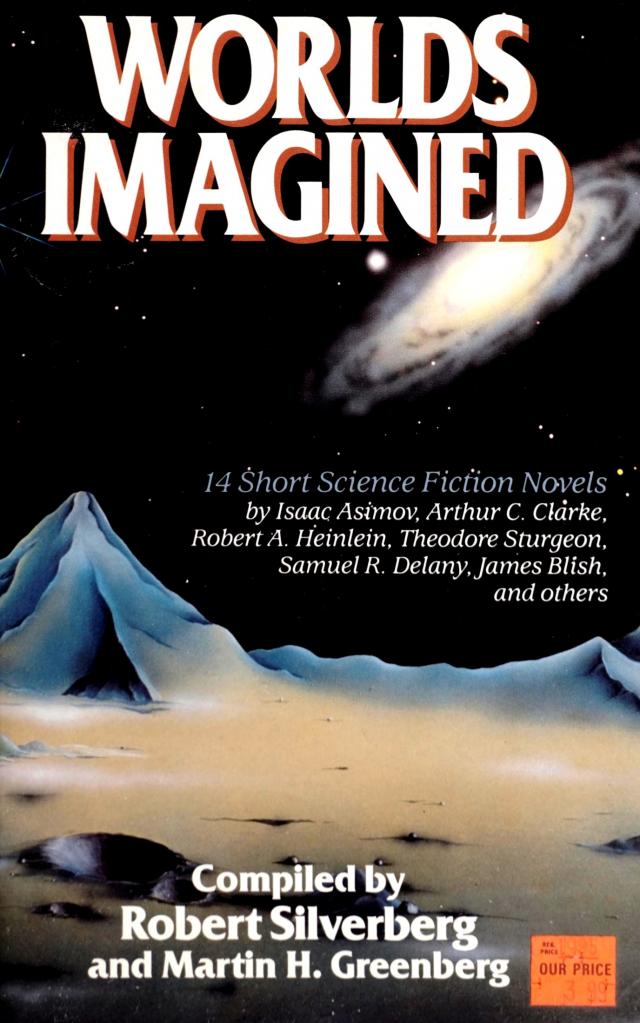
Worlds Imagined: 14 Short Science Fiction Novels is a superior collection of highly acclaimed novellas compiled and annotated by two of the field’s best known authorities. The intermediate length of the novella allows for an extensive exploration of both theme and character, without creating the structural demands of the full-length novel. In their introduction, Robert Silverberg and Martin H. Greenberg contend that this rich literary form is perfectly suited for the writer of science fiction whose task is to create fully realized, yet uncharted, worlds. Here fourteen rarely published works, many Hugo and Nebula award winners, demonstrate the effectiveness of this medium.
With the aid of such celebrated science fiction writers as Robert A. Heinlein, James Tiptree, Jr., Isaac Asimov, and Arthur C. Clarke, you can travel through time, enter alien societies, speculate about tomorrow’s breakthroughs in science and technology, and question the very nature of reality—all with the simple turn of a page.
In Wyman Guin’s wry and disturbing Beyond Bedlam, you’ll learn what it means to be normal in a society where its citizens, by law, must maintain a drug-induced schizophrenia.
WORLDS
IMAGINED
WORLDS
IMAGINED
14 Short Science Fiction Novels
Complied by
Robert Silverberg
and Martin H. Greenberg
AVENEL BOOKS
New York
Originally published in slightly different form as The Arbor
House Treasury of Great Science Fiction Short Novels.
Copyright © MCMLXXX by Robert Silverberg and
Martin H. Greenberg
All rights reserved.
This 1989 edition is published by Avenel Books, distributed by
Crown Publishers, Inc.,
225 Park Avenue South, New York, New York 10003, by arrangement with Arbor House/William Morrow & Co., Inc.
Printed and Bound in the United States of America
Library of Congress Cataloging-in-Publication Data
Worlds imagined.
Reprint. Originally published: New York:
Arbor House, cl980.
1. Science fiction, American. I. Silverberg, Robert.
II. Greenberg, Martin H.
PS648.S3W655 1989 813‘0876‘08 88-34266
ISBN 0-517-68029-7 h g f e d c b a
ACKNOWLEDGMENTS
The authors gratefully acknowledge permission to include material from the following:
“Beyond Bedlam,” by Wyman Guin. Copyright © 1951 by Galaxy
Publishing Corporation. Reprinted by permission of Larry Sternig Literary Agency.
“Equinoctial,” by John Varley. Copyright © 1977 by David Gerrold. Reprinted by permission of Kirby McCauley Ltd.
“By His Bootstraps,” by Robert A. Heinlein. Copyright © 1941 by Street & Smith. Copyright © 1968 by Robert A. Heinlein. Reprinted by permission of Robert A. Heinlein.
“The Golden Helix,” by Theodore Sturgeon. Copyright © 1954 by Standard Magazines, Inc. Reprinted by permission of Kirby McCauley Ltd.
“Born With the Dead,” by Robert Silverberg. Copyright © 1974 by Robert Silverberg. Reprinted by permission of the author.
“Second Game,” by Charles V. De Vet and Katherine MacLean. Copyright © 1958 by Street & Smith Publications, Inc. Reprinted by permission of the authors and of Virginia Kidd, Literary Agent.
“The Dead Past,” by Isaac Asimov. Copyright © 1956 by Street & Smith Publications, Inc. Reprinted by permission of the author.
“The Road to the Sea,” by Arthur C. Clarke. Copyright © 1950 by Wings Publishing Company, Inc. Reprinted by permission of the author and the author’s agents, Scott Meredith Literary Agency, Inc., 845 Third Ave., N.Y., N.Y. 10022
“The Star Pit,” by Samuel R. Delany. Copyright © 1966 by Galaxy Publishing Corporation. Reprinted by permission of the author and Henry Morrison, Inc., his agents.
“Giant Killer,” by A. Bertram Chandler. Copyright © 1945 by Street & Smith Publications, Inc. Reprinted by permission of the author and the author’s agents, Scott Meredith Literary Agency, Inc., 845 Third Ave., N.Y., N.Y. 10022
“A Case of Conscience,” by James Blish. Copyright © 1953 by Quinn Publishing Company, Inc. Reprinted by permission of Richard Curtis Associates, agents for the author’s estate.
“Dio,” by Damon Knight. Copyright © 1957 by Royal Publications, Inc. Reprinted by permission of the author.
“Houston, Houston, Do You Read?” by James Tiptree, Jr. Copyright © 1976 by Fawcett Publications, Inc. Reprinted by permission of the author’s agent, Robert P. Mills, Ltd.
“On the Storm Planet,” by Cordwainer Smith. Copyright © 1965 by Galaxy Publishing Corporation. Reprinted by permission of Scott Meredith Literary Agency, Inc., 845 Third Ave., N.Y., N.Y. 10022, agents for the author’s estate.
Contents:-
ACKNOWLEDGMENTS
Introduction
WORLDS
IMAGINED
Beyond Bedlam
Equinoctial
By His Bootstraps
The Golden Helix
Born With the Dead
Second Game
The Dead Past
The Road to the Sea
The Star Pit
Giant Killer
A Case of Conscience
Dio
Houston, Houston, Do You Read?
On the Storm Planet
Introduction
The short novel—or “novella/* as some prefer to call it—is one of the richest and most rewarding of literary forms. Spanning twenty to thirty thousand words, usually, it allows for more extended development of theme and character than does the short story, without making the elaborate structural demands of the full-length book. Thus it provides an intense, detailed exploration of its subject, partaking to some degree both of the concentrated focus of the short story and of the broad scope of the novel.
Some of the greatest works of modern literature fall into the class of novellas. Consider Mann’s “Death in Venice,” Joyce’s “The Dead,” Melville’s “Billy Budd,” and Conrad’s “Heart of Darkness”—or Faulkner’s “The Bear,” Tolstoi’s “The Death of Ivan Ilych,” Carson McCullers’s “Ballad of the Sad Cafe.” Yet for all its triumphs, the novella has proven to be an awkward item in the world of commercial publishing, generally too short to stand alone as an independent book, too long to fit into the conventional collection of short pieces. Only through special efforts are even the finest of short novels kept before the reading public.
That problem has been particularly acute in science fiction, a field that lends itself with unusual grace to the novella form. Since a prime task of the science fiction writer is to create carefully detailed worlds of the imagination, room for invention is a necessity. The short story can give only a single vivid glimpse of the invented world; the full-length novel frequently becomes so enmeshed in the obligations of plot and counterplot that the background recedes to a secondary position. But the short novel, leisurely without being discursive, is ideal for the sort of world-creation that is science fiction’s specialty, and since the days of H.G. Wells and his classic novella “The Time Machine” it has exerted a powerful attraction for science fiction writers. Because science fiction magazines, for many years the dominant vehicle for publication of imaginative stories, were generally receptive to stories of the middle lengths, an abundant literature of science fiction novellas has accrued.
But in the transfer from magazine to book the usual problems of publishing conventions have intervened. Some writers have resorted to expanding classic twenty-five thousand-word stories into novels of the traditional sixty thousand to seventy-five thousand words, not always with happy results; others have included their novellas in collections of their short stories, and such collections rarely get the attention that novels do; and although anthologies of short science fiction stories abound, few of them have the space to include more than one or two novellas. Even in our own 736-page Great Science Fiction of the 20th Century there was room for only three or four stories that could be considered short novels.
To demonstrate the extraordinary potential of the science fiction novella, then, we have compiled a companion volume of equal size, containing fourteen major works in this odd but highly satisfying intermediate length. They include stories written between 1941 and 1977. Nearly all these novellas were warmly acclaimed when they first were published—there are a good many Hugo and Nebula award winners among them—but because of the inconveniences their length can cause, many of them now are difficult to find in current editions. It gives us great pleasure to return them to print in a book big enough to accommodate so many of them, and thus able to show by example after example how superbly fitted the novella form is for the creation of the unique “pocket universes” of science fiction.
—Robert Silverberg
—Martin Harry Greenberg
WORLDS
IMAGINED
WYMAN GUIN
Beyond Bedlam
Travel to the moon, to the planets of our solar system, and to the stars used to be considered the essence of science fiction. However, in the last three decades some of the most imaginative and remarkable works in this field have focused on the flights that take place in “inner space, ” examining the nature of normality and reality.
In the magnificent and pioneering “Beyond Bedlam, ” Wyman Guin writes of what it means to be “normal* in a world of uni versal schizophrenia.
The opening afternoon class for Mary Walden’s ego-shift was almost over, and Mary was practically certain the teacher would not call on her to recite her assignment, when Carl Blair got it into his mind to try to pass her a dirty note. Mary knew it would be a screamingly funny ego-shifting room limerick and was about to reach for the note when Mrs. Harris’s voice crackled through the room.
“Carl Blair! I believe you have an important message. Surely you will want the whole class to hear it. Come forward, please.”
As he made his way before the class, the boy’s blush-covered freckles reappeared against his growing pallor. Haltingly and in an agonized monotone, he recited from the note:
“There was a young hyper named Phil,
Who kept a third head for a thrill.
Said he, Its all right,
I enjoy my plight.
I shift my third out when it’s chill.’
“
The class didn’t dare laugh. Their eyes burned down at their laps in shame. Mary managed to throw Carl Blair a compassionate glance as he returned to his seat, but she instantly regretted ever having been kind to him.
“Mary Walden, you seemed uncommonly interested in reading some- thing just now. Perhaps you wouldn’t mind reading your assignment to the class.”
There it was, and just when the class was almost over. Mary could have scratched Carl Blair. She clutched her paper grimly and strode to the front.
’Today’s assignment in pharmacy history is, ‘Schizophrenia Since the Ancient Prepharmacy Days.’
” Mary took enough breath to get into the first paragraph.
“Schizophrenia is where two or more personalities live in the same brain. The ancients of the twentieth century actually looked upon schizophrenia as a disease! Everyone felt it was very shameful to have a schizophrenic person in the family, and, since children lived right with the same parents who had borne them, it was very bad. If you were a schizophrenic child in the twentieth century, you would be locked up behind bars and people would call you—”
Mary blushed and stumbled over the daring word—crazy. “The ancients locked up strong ego groups right along with weak ones. Today we would lock up those ancient people.”
The class agreed silently.
“But there were more and more schizophrenics to lock up. By 1950 the prisons and hospitals were so full of schizophrenic people that the ancients did not have room left to lock up any more. They were beginning to see that soon everyone would be schizophrenic.
“Of course, in the twentieth century, the schizophrenic people were almost as helpless and ‘crazy’ as the ancient Modern men. Naturally they did not fight wars and lead the silly life of the Moderns, but without proper drugs they couldn’t control their ego-shiftability. The personalities in a brain would always be fighting each other. One personality would cut the body or hurt it or make it filthy, so that when the other personality took over the body, it would have to suffer. No, the schizophrenic people of the twentieth century were almost as ‘crazy’ as the ancient Moderns.
“But then the drugs were invented one by one and the schizophrenic people of the twentieth century were freed of their troubles. With the drugs the personalities of each body were able to live side by side in harmony at last. It turned out that many schizophrenic people, called overendowed personalities, simply had so many talents and viewpoints that it took two or more personalities to handle everything.
“The drugs worked so well that the ancients had to let millions of schizophrenic people out from behind the bars of ‘crazy’ houses. That was the Great Emancipation of the 1990’s. From then on, schizophrenic people had trouble only when they criminally didn’t take their drugs. Usually, there are two egos in a schizophrenic person—the hyperalter, or prime ego, and the hypoalter, the alternate ego. There often were more than two, but the Medicorps makes us take our drugs so that won’t happen to us.
“At last someone realized that if everyone took the new drugs, the great wars would stop. At the World Congress of 1997, laws were passed to make everyone take the drugs. There were many fights over this because some people wanted to stay Modern and fight wars. The Medicorps was organized and told to kill anyone who wouldn’t take their drugs as prescribed. Now the laws are enforced and everybody takes the drugs and the hyperalter and hypoalter are each allowed to have the body for an ego-shift of five days…”
Mary Walden faltered. She looked up at the faces of her classmates, started to turn to Mrs. Harris and felt the sickness growing in her head. Six great waves of crescendo silence washed through her. The silence swept away everything but the terror, which stood in her frail body like a shrieking rock.
Mary heard Mrs. Harris hurry to the shining dispensary along one wall of the classroom and return to stand before her with a swab of antiseptic and a disposable syringe.
Mrs. Harris helped her to a chair. A few minutes after the expert injection, Mary’s mind struggled back from its core of silence.
“Mary, dear, I’m sorry. I haven’t been watching you closely enough.”
“Oh, Mrs. Harris…” Mary’s chin trembled. “I hope it never happens again.”
“Now, child, we all have to go through these things when we’re young. You’re just a little slower than the others in acclimatizing to the drugs. You’ll be fourteen soon and the medicop assures me you’ll be over this sort of thing just as the others are.”
Mrs. Harris dismissed the class and when they had all filed from the room, she turned to Mary.
“I think, dear, we should visit the clinic together, don’t you?”
“Yes, Mrs. Harris.” Mary was not frightened now. She was just ashamed to be such a difficult child and so slow to acclimatize to the drugs.
As she and the teacher walked down the long corridor to the clinic, Mary made up her mind to tell the medicop what she thought was wrong.
It was not herself. It was her hypoalter, that nasty little Susan Shorrs. Sometimes, when Susan had the body, the things Susan was doing and thinking came to Mary like what the ancients had called dreams, and Mary had never liked this secondary ego whom she could never really know. Whatever was wrong, it was Susan’s doing. The filthy creature never took care of her hair, it was always so messy when Susan shifted the body to her.
Mrs. Harris waited while Mary went into the clinic.
Mary was glad to find Captain Thiel, the nice medicop, on duty. But she was silent while the X rays were being taken, and, of course, while he got the blood samples, she concentrated on being brave.
Later, while Captain Thiel looked in her eyes with the bright little light, Mary said calmly, “Do you know my hypoalter, Susan Shorrs?”
The medicop drew back and made some notes on a pad before answering. “Why, yes. She’s in here quite often too.”
“Does she look like me?”
“Not much. She’s a very nice little girl…” He hesitated, visibly fumbling.
Mary blurted, “Tell me truly, what’s she like?”
Captain Thiel gave her his nice smile. “Well, I’ll tell you a secret if you keep it to yourself.”






